By- Mahmoud Kamara Government Information Officer
Freetown, Sierra Leone —
Sierra Leone is making significant strides toward sustainable development, despite global economic headwinds and climate-related pressures. This is according to the 2025 Mid-Year Progress Report released by the United Nations under the UN Sustainable Development Cooperation Framework (UNSDCF), covering progress from January to June 2025.
The report, launched in close partnership with the Government of Sierra Leone, commends the country’s resilience and reform agenda, which continues to drive transformation in key sectors including education, health, governance, agriculture, and economic development.
Economic Stability Amid Reform
The economy remains on a steady growth path, with GDP projected at 4.5% for 2025 following the 2024 rebasing that placed Sierra Leone’s economy at USD 8 billion—double the previous estimate. Inflation has dropped dramatically from 47% in January 2024 to 7.1% by June 2025, signaling improved economic management.
However, fiscal challenges persist, with the revenue-to-GDP ratio at 9.8% and a budget deficit of 8.5%, underscoring the need for continued reforms and external support.
Investing in People: Education and Health
Human capital development is at the heart of national progress. Net school enrollment has reached 94%, with gender parity achieved at the primary level. Over 527,000 learners accessed foundational materials and 257,000 pupils benefited from school feeding programs. Additionally, 220 School Quality Assurance Officers have been deployed to improve teaching and learning outcomes.
In the health sector, maternal mortality continues to decline, standing at 354 per 100,000 live births, while neonatal survival in Special Care Baby Units has improved to 90%. Nearly 150,000 people have also been vaccinated against Mpox, demonstrating strong public health response capacity.
Climate Action and Food Security
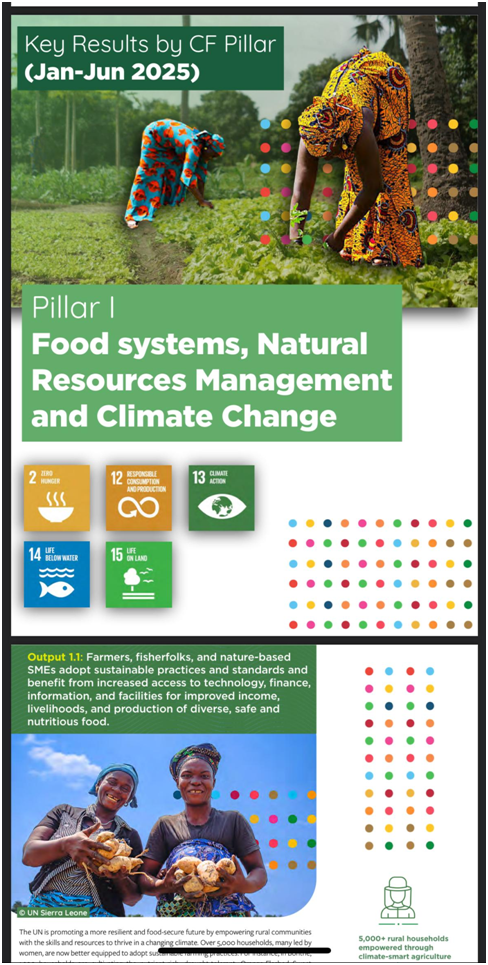
Efforts to strengthen climate resilience and food systems have gained traction. More than 5,000 households, predominantly women farmers, have been trained in climate-smart agriculture. Farmers have also begun enrolling in Sierra Leone’s first climate risk insurance scheme, while solar-powered water systems now serve over 55,000 people across 16 rural communities.
Livelihood support programs have provided thousands of families with poultry, goats, and energy-efficient fish dryers, contributing to income generation and nutritional improvements.
Governance and Economic Transformation
On the governance front, Sierra Leone is leveraging technology and policy reform to foster accountability and investment. Key milestones include the validation of the National Export Strategy, aligned with the African Continental Free Trade Area (AfCFTA), and the launch of an online business registration portal to ease private sector engagement.
The National Action Plan on Women, Peace, and Security has expanded women’s participation in peacebuilding, while over 2,500 vulnerable girls have been reintegrated into schools using digital tools. A new Social Protection Bill has also been enacted to strengthen the nation’s safety net framework.
The government has further improved transparency through the launch of the Medium-Term National Development Plan (MTNDP) results dashboard and reforms in civil registration and vital statistics.
Challenges Remain
Despite these achievements, the UN highlights several critical challenges. A financing gap of $76.6 million remains to fully support 2025 UN programs. Meanwhile, climate shocks and persistent data limitations continue to hinder evidence-based decision-making and long-term resilience planning.
A Call for Continued Partnership
The United Nations praised the leadership of President Julius Maada Bio and the enduring partnership with the Government of Sierra Leone, civil society, and the private sector. The report reaffirms the shared commitment to ensuring that no one is left behind in the national development journey.
“The resilience of the Sierra Leonean people is the foundation of the country’s progress,” the report states. “Together, we are proving that transformative change is not only possible—it is already happening.”
As Sierra Leone moves into the second half of 2025, the UN and its partners remain committed to accelerating inclusive, sustainable development across the country.